

Digital disruption is set to determine which businesses thrive and which struggle by 2026. The pace of digital change is accelerating, and those unable to adapt risk being left behind in an increasingly competitive landscape.
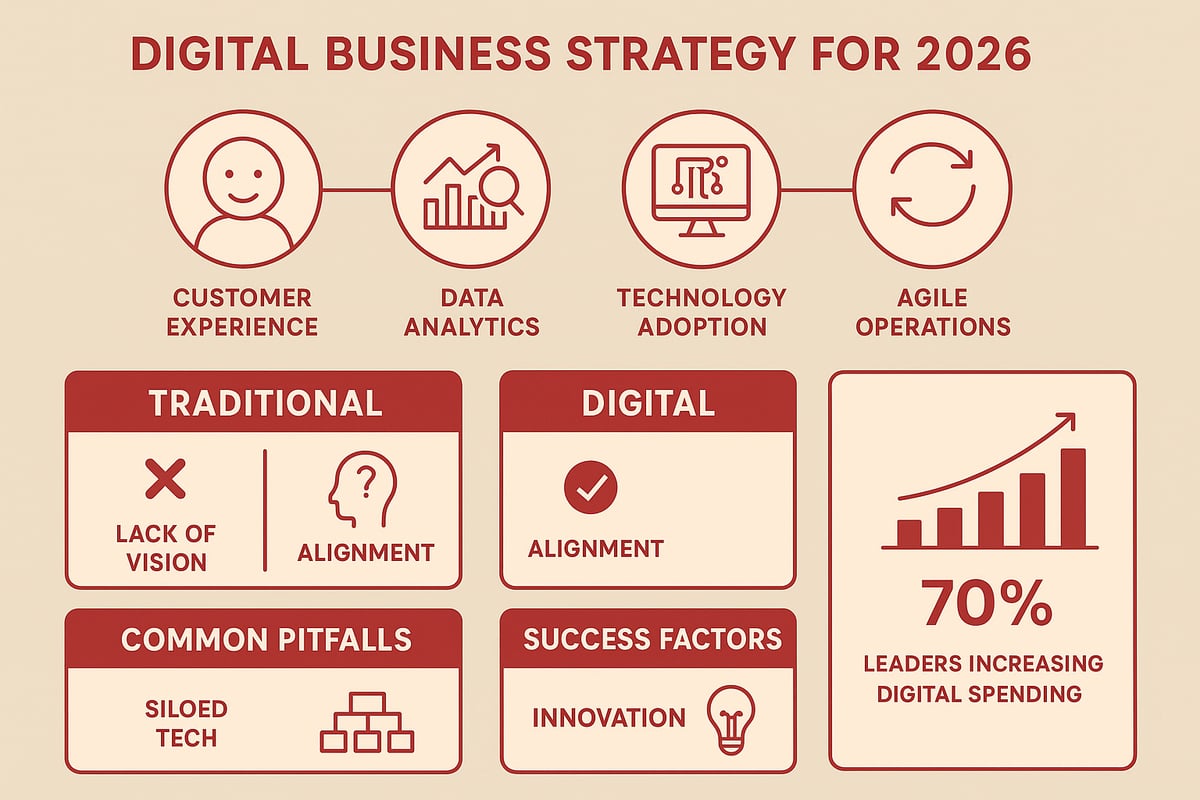
Recent data from Tech Pro Research reveals that 70% of business leaders are increasing investment in digital business strategy. This shift creates new opportunities for organizations willing to embrace growth, resilience, and innovation.
This guide offers a comprehensive roadmap to mastering digital business strategy in 2026. Expect actionable steps, proven frameworks, and forward-thinking insights designed to help your organization succeed in the digital economy.
You will discover how to define digital business strategy, explore key trends, develop a step-by-step plan, integrate technology, measure success, and learn from real-world examples.
Understanding Digital Business Strategy in 2026
Defining Digital Business Strategy
A digital business strategy is more than a plan for adopting new technology. It is a holistic approach that integrates digital tools, processes, and mindsets into every aspect of an organization. Unlike traditional strategies, it centers on adaptability and continuous value creation.
In 2026, digital business strategy means reimagining business models, leveraging data, and focusing on customer-centric experiences. The shift since the pandemic has moved organizations from basic automation to building resilience and unlocking new growth.
This alignment of digital initiatives with core business goals drives innovation and efficiency. For more on how companies are redefining business models, see Digital businesses and transformation.
Core Components of a Modern Digital Strategy
Modern digital business strategy relies on several essential elements. First, customer experience is at the center, demanding seamless, personalized interactions. Technology adoption is not just about tools, but about integrating platforms that support agility and scalability.
Data-driven decision-making enables organizations to identify opportunities and optimize operations. Agile operations ensure teams can pivot quickly when needed. Stakeholder journey mapping and value chain transformation help deliver unified experiences.
A balanced roadmap is crucial for improving digital maturity. According to Tech Pro Research, 70 percent of leaders are increasing digital investment, highlighting the urgency of a comprehensive digital business strategy.
Why Digital Strategy Matters in 2026
The importance of digital business strategy in 2026 cannot be overstated. It is the foundation for resilience, adaptability, and growth. Without a robust digital approach, organizations risk losing relevance, market share, and operational efficiency.
Digital customer expectations are rising fast, and those who do not evolve fall behind. Competitors report significant cost savings and better alignment by prioritizing digital transformation. Companies that neglect digital business strategy often struggle, missing out on innovation and profitability.
Success in the digital era requires proactive adaptation, or businesses risk being left behind in a changing landscape.
Key Challenges and Pitfalls
Despite its importance, digital business strategy faces several obstacles. Common pitfalls include lack of vision, poor implementation, and siloed technology adoption. Outdated strategies and inadequate stakeholder buy-in can stall progress.
Measurement is often insufficient, making it hard to track impact and adjust. Competitors note that many strategies fail due to a lack of actionable guidance or clear direction. Overcoming resistance to change requires strong leadership and team alignment.
Real-world feedback, such as testimonials from Info-Tech Research Group, highlights the need for clear communication and continuous improvement to achieve true digital transformation.
Digital Trends Reshaping Business in 2026
The digital landscape for 2026 is rapidly evolving, transforming how organizations build and execute their digital business strategy. Leading companies are adapting to seismic shifts in technology, customer expectations, data usage, and security requirements. Understanding these trends is essential for creating a resilient and future-ready digital business strategy.
Emerging Technologies Driving Transformation
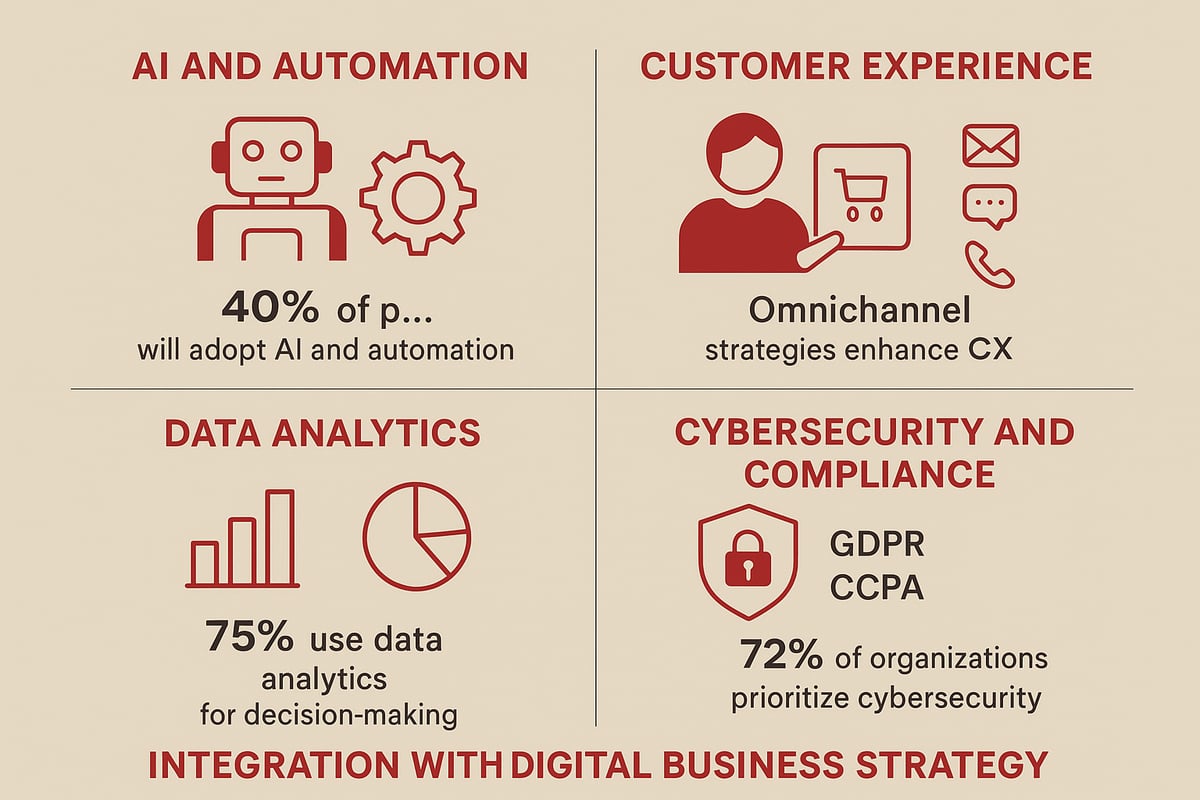
In 2026, emerging technologies are at the core of every successful digital business strategy. Artificial intelligence, machine learning, IoT, 5G, and blockchain are not just buzzwords—they are fundamentally reshaping business models and operations. Automation is expanding beyond routine tasks, enabling companies to tackle complex cognitive activities with greater speed and precision.
Cloud computing and edge technologies are driving agility and scalability, empowering organizations to adapt quickly to market changes. Sectors like healthcare and manufacturing are seeing transformative impacts, with intelligent systems optimizing patient care and supply chains. According to industry reports, adoption rates for AI and 5G are projected to double by 2026. For a deeper dive into the most influential technologies set to redefine the business landscape, review the Emerging Technologies Driving Transformation resource.
Evolving Customer Expectations and Experiences
Customer expectations are rapidly shifting, making digital experience a critical pillar of any digital business strategy. Hyper-personalization, real-time service, and seamless omnichannel engagement are no longer optional—they are requirements for customer loyalty and retention.
Businesses are mapping digital customer journeys to deliver tailored interactions at every touchpoint. Companies excelling in digital CX are leveraging technology to anticipate needs and resolve issues instantly. Recent studies reveal that over 70 percent of customers now prefer digital-first engagement, highlighting the urgency for organizations to invest in advanced customer experience capabilities.
Data, Analytics, and Business Intelligence
Data-driven decision-making is central to a successful digital business strategy. The strategic use of big data, analytics, and business intelligence tools allows organizations to unlock predictive insights, identify growth opportunities, and optimize operations in real time.
Integrating business intelligence platforms streamlines the process of transforming raw data into actionable strategies. Data-driven organizations consistently outperform their competitors, as they can react faster to market shifts and customer needs. Competitor research shows that incorporating analytics as a core strategy element leads to measurable improvements in efficiency and innovation.
Security, Privacy, and Compliance
Security, privacy, and compliance are increasingly vital to digital business strategy as digital transformation accelerates. Cybersecurity threats are becoming more sophisticated, and regulatory requirements such as GDPR and CCPA are evolving, placing greater demands on organizations to protect data and ensure compliance.
Proactive risk management, robust incident response plans, and integrated security frameworks are best practices for safeguarding digital assets. Notable breaches and compliance failures have underscored the significant business risks of neglecting security. Organizations that embed security by design into their digital business strategy are better positioned to maintain trust and achieve sustainable growth.
Step-by-Step Guide to Building a Winning Digital Business Strategy
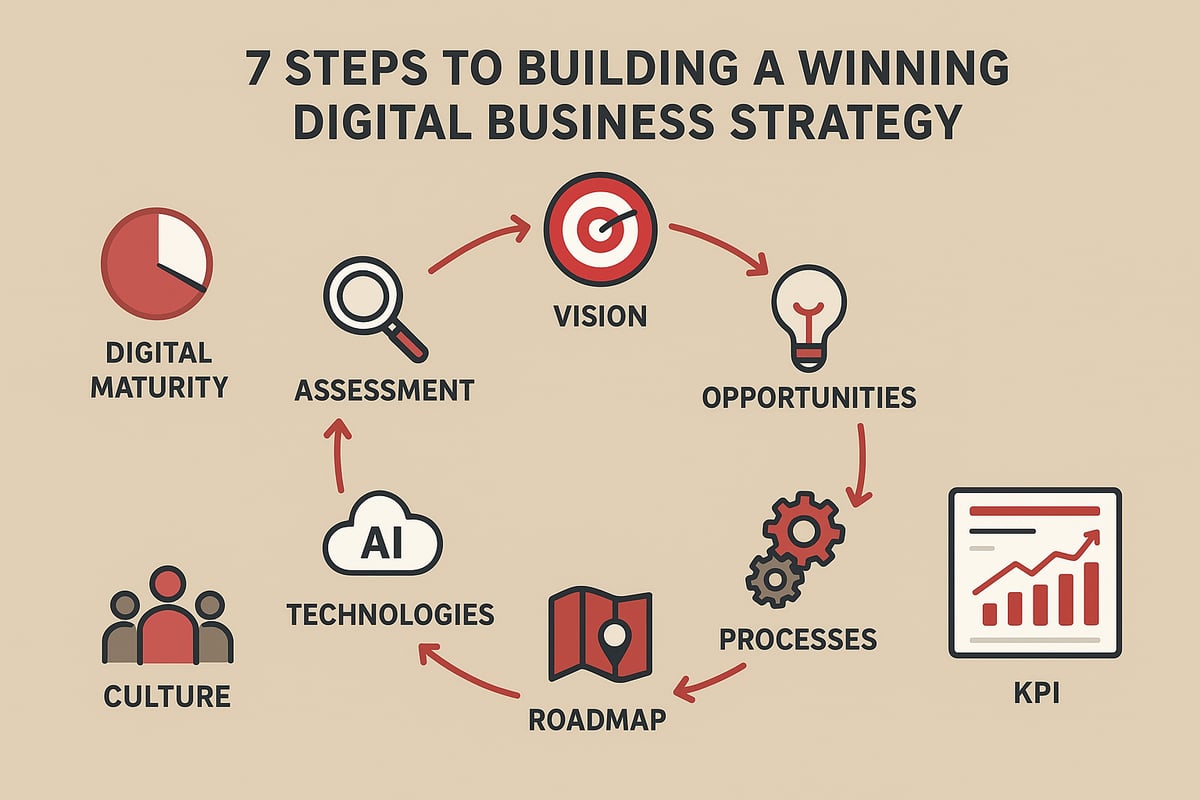
Building a robust digital business strategy for 2026 requires a methodical, step-by-step approach. Each phase lays the foundation for growth, resilience, and innovation. By following these seven essential steps, organizations can navigate complexity and unlock new opportunities.
Step 1: Assess Current State and Digital Maturity
The first step in crafting a digital business strategy is understanding where your organization stands today. Conduct a digital maturity assessment covering technology, processes, culture, and capabilities. Leverage frameworks like value chain analysis and journey mapping to pinpoint strengths and weaknesses.
Engage stakeholders from across departments to gather diverse perspectives. This collaboration uncovers hidden challenges and opportunities. Many leading companies use maturity assessments as a compass, guiding their digital business strategy and highlighting priority areas for transformation.
- Use digital maturity models to benchmark progress.
- Collect feedback from both leadership and frontline teams.
- Map current workflows to identify inefficiencies.
A thorough assessment ensures your digital business strategy starts from a place of clarity and alignment.
Step 2: Define Vision, Goals, and Success Metrics
A compelling digital business strategy begins with a clear vision that aligns with broader organizational objectives. Define what success looks like in concrete terms. Set measurable goals, such as revenue growth, improved efficiency, enhanced customer satisfaction, or accelerated innovation.
Identify key performance indicators (KPIs) that track progress and outcomes. Competitors recommend using a balanced roadmap, blending ambitious targets with achievable milestones. Real-world success stories show that vision-driven digital business strategies inspire teams and focus efforts.
- Articulate your digital vision in a concise statement.
- Select 3–5 KPIs that align with your objectives.
- Communicate goals across all levels of the organization.
Clear vision and metrics form the backbone of any successful digital business strategy.
Step 3: Identify and Prioritize Digital Opportunities
Next, scan your market for emerging trends, evolving customer needs, and enabling technologies. Use horizon scanning and opportunity mapping to discover where digital initiatives can have the greatest impact. Prioritize opportunities based on potential value, feasibility, and strategic fit.
Competitor tools like journey mapping can help visualize and expand these opportunities. Organizations that carefully prioritize projects within their digital business strategy often achieve faster wins and greater long-term results.
- Assess customer pain points and unmet needs.
- Evaluate technology trends relevant to your sector.
- Score opportunities using an impact-feasibility matrix.
Prioritization keeps your digital business strategy focused and adaptable in a rapidly changing landscape.
Step 4: Design and Optimize Digital Processes
With opportunities identified, the next step is to reimagine business processes for efficiency and agility. Leverage automation, integration, and digital tools to streamline workflows. Focus on enhancing both customer and employee experiences.
Process transformation is central to building resilience and supporting growth. Competitor research highlights the importance of mapping stakeholder journeys and optimizing each touchpoint. Companies that optimize processes as part of their digital business strategy often realize significant cost savings and performance gains.
- Automate repetitive tasks to free up human creativity.
- Integrate systems for seamless data flow.
- Continuously test and refine processes for improvement.
Optimized processes are vital for a high-performing digital business strategy.
Step 5: Select and Integrate Enabling Technologies
Choosing the right technologies is critical to executing your digital business strategy effectively. Evaluate options such as platforms, software, and infrastructure for scalability and alignment with your goals. Avoid adopting technology in silos; instead, ensure each solution integrates smoothly with existing systems.
Best practices include phased rollouts, strong change management, and ongoing evaluation. Explore the latest Digital Transformation Trends to inform your technology decisions and stay ahead of the curve.
- Assess cloud, AI, automation, and analytics solutions.
- Plan for interoperability and future scalability.
- Involve both IT and business leaders in selection processes.
Strategic technology integration is the engine of a winning digital business strategy.
Step 6: Build the Roadmap and Implementation Plan
A phased, actionable roadmap brings your digital business strategy to life. Define clear timelines, milestones, and responsibilities for each initiative. Use tools like Gantt charts to visualize dependencies and track progress.
Leverage competitor templates to structure your transformation roadmap. Flexibility is key; allow room for adjustments based on feedback and changing conditions. Effective resource allocation and cross-functional teamwork drive successful implementation.
- Break initiatives into manageable phases.
- Assign project owners and clarify roles.
- Monitor progress and adapt as needed.
A well-structured roadmap ensures your digital business strategy moves from concept to reality.
Step 7: Foster a Culture of Innovation and Agility
Sustaining digital business strategy success requires a culture that embraces change, experimentation, and continuous learning. Encourage cross-functional teams to share ideas and iterate rapidly. Change management and transparent communication build trust and buy-in at all levels.
Leadership plays a pivotal role in modeling a digital mindset. Competitor insights emphasize the value of collaboration and empowerment. Organizations with robust innovation cultures consistently outperform peers with rigid, traditional structures.
- Celebrate small wins and lessons learned.
- Provide training and development opportunities.
- Foster open communication and feedback loops.
An agile, innovative culture is the final ingredient for a resilient digital business strategy.
Integrating Technology for Competitive Advantage
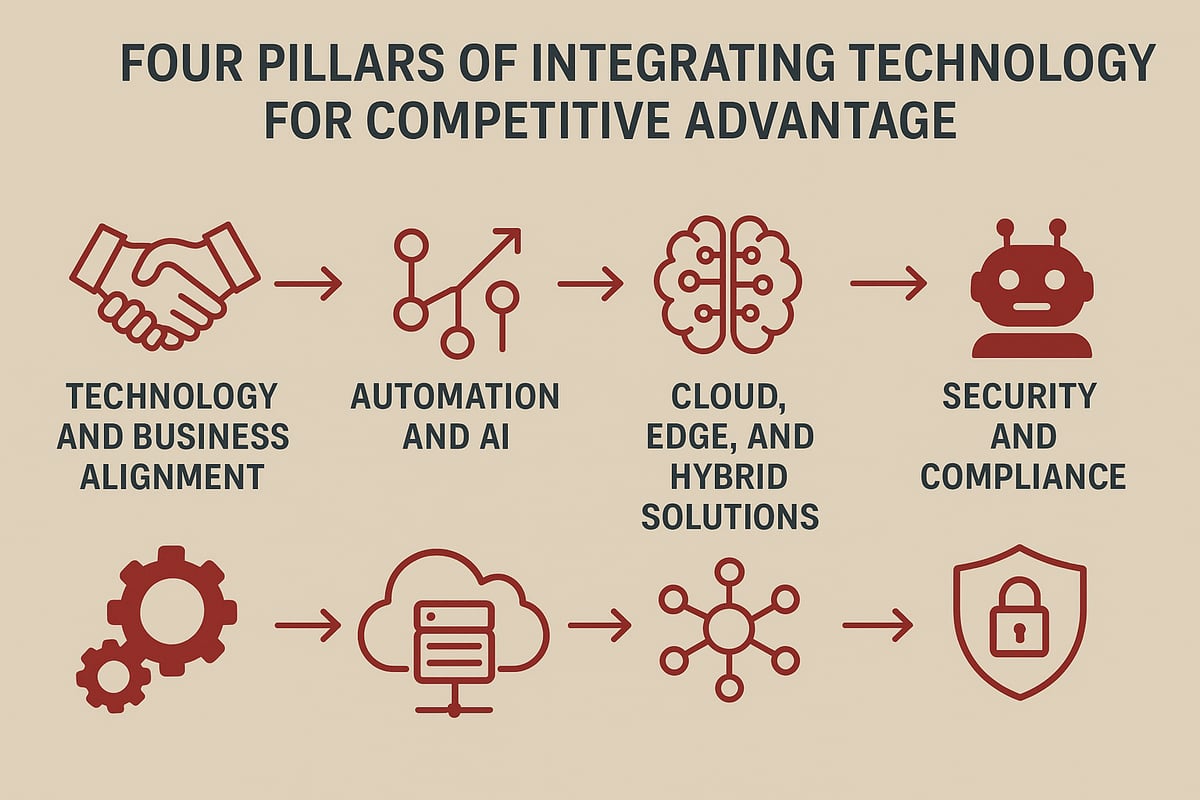
Organizations must skillfully integrate technology to unlock the full potential of their digital business strategy. By aligning technology with core business objectives, leveraging automation and AI, optimizing cloud and edge solutions, and embedding security by design, companies can create lasting competitive advantages.
Aligning Technology with Business Strategy
To maximize value, every technology investment should reinforce the digital business strategy. This means selecting tools and platforms that directly support business goals, not just adopting the latest trends.
Successful organizations build a unified roadmap where IT and business work together. They map technology initiatives to strategic objectives, ensuring resources drive measurable outcomes.
For example, a retailer integrating CRM and analytics platforms can boost personalized marketing, directly enhancing customer engagement and sales. The result is a tighter link between digital business strategy and operational success.
Benefits of Alignment:
| Benefit | Description |
|---|---|
| Increased ROI | Investments tied to objectives |
| Greater Agility | Faster response to market changes |
| Reduced Silos | Unified vision across departments |
Leveraging Automation and AI
Automation and AI are transforming how businesses operate, making them essential to any modern digital business strategy. From intelligent chatbots to predictive analytics, these technologies streamline processes, improve accuracy, and create new growth opportunities.
Leaders are integrating AI into marketing, operations, and customer service, driving efficiency and innovation. By 2026, the use of generative AI is expected to become mainstream, fueling creative problem solving and rapid adaptation. For a deep dive on this trend, see AI and Generative AI Integration.
Industries such as healthcare and manufacturing are already realizing significant ROI by automating complex, non-routine tasks. These advances enable organizations to focus on strategic priorities and accelerate digital business strategy outcomes.
Cloud, Edge, and Hybrid Solutions
Cloud, edge, and hybrid solutions are foundational to a robust digital business strategy, offering the flexibility and scalability required in today’s landscape. Organizations can quickly scale operations, support remote work, and deploy new services without major infrastructure investments.
Cloud platforms enable seamless data sharing and collaboration, while edge computing supports real-time processing closer to the data source. Hybrid approaches combine the best of both, balancing performance, cost, and compliance needs.
For example, manufacturers adopting hybrid cloud can optimize production lines and supply chains, responding rapidly to changes in demand. Effective use of these solutions ensures digital business strategy remains agile and future-ready.
Ensuring Security and Compliance by Design
Security and compliance must be embedded into every stage of digital business strategy. As regulatory requirements tighten and threats become more sophisticated, proactive risk management is critical.
Organizations adopt robust frameworks—such as regular security audits, employee training, and automated monitoring—to protect data and ensure compliance. Integrating security with technology selection and deployment reduces vulnerabilities and builds stakeholder trust.
Security Best Practices:
- Conduct regular risk assessments
- Implement multi-factor authentication
- Maintain up-to-date compliance documentation
By prioritizing security and compliance, companies not only protect their assets but also strengthen the foundation of their digital business strategy.
Measuring, Managing, and Optimizing Digital Strategy
Modern organizations cannot afford to treat measurement as an afterthought in their digital business strategy. Success in 2026 relies on a disciplined approach to tracking, managing, and optimizing performance, ensuring that every digital initiative delivers real business value.
Setting KPIs and Measuring Success
Defining the right KPIs is the cornerstone of an effective digital business strategy. Metrics should reflect business outcomes, not just digital activity. Common KPIs include revenue growth, customer retention, digital adoption rates, and customer satisfaction.
A sample KPI table:
| KPI | Description | Example Tool |
|---|---|---|
| Revenue Growth | Increase in digital sales | Power BI |
| Customer Retention | Repeat purchase rates | Salesforce |
| Digital Adoption | Usage of digital platforms | Google Analytics |
| Engagement | Interaction across channels | Customer engagement in digital marketing |
Real-time dashboards help teams monitor progress and make informed decisions. Linking KPIs directly to business goals ensures your digital business strategy remains focused and actionable.
Continuous Improvement and Agile Iteration
Continuous improvement is at the heart of successful digital business strategy execution. Agile methodologies enable teams to adapt quickly, experiment, and refine tactics based on data and feedback.
Regular retrospectives help identify what is working and what needs adjustment. Businesses that embrace agile iteration often outperform competitors by pivoting in response to market or technology shifts.
Short feedback cycles and incremental enhancements reduce risk and drive ongoing value. Embedding agile principles ensures your digital business strategy stays relevant and resilient.
Overcoming Barriers and Ensuring Stakeholder Buy-In
Common obstacles to digital business strategy optimization include resistance to change, limited resources, and misaligned incentives. Achieving stakeholder buy-in starts with transparent communication and clear demonstration of value.
Strategies for overcoming barriers:
- Host inclusive workshops to gather input
- Align incentives with digital goals
- Secure executive sponsorship early
- Foster a culture of collaboration
Case studies show that organizations with strong stakeholder engagement are more likely to sustain digital transformation momentum and realize their objectives.
Scaling and Sustaining Digital Success
Scaling digital business strategy requires robust governance, resource planning, and a commitment to continuous learning. Establishing cross-functional teams and clear processes supports long-term sustainability.
Best practices include:
- Ongoing upskilling to keep pace with technology
- Regular reviews of governance frameworks
- Monitoring industry trends to anticipate disruption
Leaders who invest in strategic scaling protect their organizations from stagnation and ensure digital initiatives deliver lasting impact. The most successful companies prioritize adaptability and foster a mindset of perpetual growth.
Real-World Examples and Lessons Learned
Digital business strategy is best understood through real-world stories and practical insights. Organizations around the globe are redefining their futures by embracing digital transformation, learning from both their successes and setbacks. This section explores proven examples, common pitfalls, industry-specific approaches, and strategies for future-proofing your digital business strategy.
Case Studies of Digital Transformation Success
A well-executed digital business strategy can yield remarkable results. For example, a major healthcare provider streamlined patient intake processes, cutting administrative time by 120 days and saving $1.36M, according to competitor testimonials. In manufacturing, companies adopting digital twins and IoT have reported significant efficiency gains and reduced downtime.
Education institutions leveraging digital platforms have expanded access and improved learning outcomes. Success often hinges on strong leadership, alignment of technology with business goals, and a clear execution plan. Direct client feedback repeatedly highlights the value of investing in digital business strategy for measurable impact.
Common Pitfalls and How to Avoid Them
Despite the promise of digital business strategy, many organizations fall short. Common pitfalls include lack of focus, weak facilitation, and strategies that fail to address unique business needs. Negative feedback from competitor testimonials emphasizes the importance of tailored approaches and effective change management.
To avoid these issues, organizations should:
- Ensure leadership commitment from the start
- Customize the digital business strategy to fit their context
- Facilitate regular feedback and course corrections
Practical tips include engaging stakeholders early and leveraging lessons learned from previous initiatives to drive continuous improvement.
Industry-Specific Strategies for 2026
Every industry faces distinct challenges and opportunities when shaping a digital business strategy. In oil & gas, digital monitoring enhances safety and operational efficiency. Healthcare organizations are prioritizing data security and telemedicine. Construction firms are integrating project management platforms for real-time collaboration, while retail is moving rapidly toward omnichannel experiences.
For retail leaders, exploring digital marketing for retail trends can help align strategy with evolving customer expectations. Industry-specific digital business strategy frameworks ensure compliance, innovation, and long-term growth by addressing sector regulations and emerging technologies.
Future-Proofing Your Digital Business Strategy
Anticipating future trends is essential for sustaining digital business strategy success. Organizations that regularly perform horizon scanning and trend analysis are better equipped to adapt to market shifts. Competitor advice underscores the value of flexible, adaptable frameworks that evolve as technology and customer demands change.
Examples abound of companies that have embedded continuous learning and agile methodologies into their digital business strategy, successfully navigating disruptions and maintaining leadership in their sectors. The key is to invest in tools and training that support ongoing digital maturity and resilience.
As you look ahead to 2026, shaping a digital business strategy is more than just keeping up—it's about setting your brand apart through genuine relationships and purposeful innovation. We've unpacked the latest trends, practical frameworks, and real-world insights to help you build resilience and drive growth. If you're ready to see how a holistic approach truly comes to life, I invite you to explore real examples of success. Dive into our portfolio to discover how Red Van Creative’s expertise in digital strategy, branding, and design can spark new opportunities for your organization.
See Our Work / View Our Portfolio