
Building a successful social media marketing strategy requires more than posting content and hoping for engagement. In 2026, businesses face an increasingly complex landscape where authenticity, consistency, and strategic planning separate thriving brands from those struggling to gain traction. Whether you’re in healthcare, construction, oil and gas, or retail, your approach to social media must reflect both your brand values and your audience’s evolving expectations. The foundation of any effective strategy lies in understanding your objectives, knowing your audience intimately, and creating content that builds genuine connections rather than simply chasing vanity metrics.
Understanding Your Business Objectives
Before launching into content creation, define what success looks like for your organization. A social media marketing strategy must align with broader business goals, whether that means driving website traffic, generating qualified leads, building brand awareness, or establishing thought leadership in your industry.
Common social media objectives include:
- Increasing brand recognition within specific geographic markets
- Driving qualified traffic to service pages or product listings
- Building a community around your brand values
- Generating leads through targeted campaigns
- Providing customer support and enhancing satisfaction
- Establishing authority in specialized industries
For Houston-based businesses, local connection often plays a crucial role in these objectives. Your strategy should reflect regional priorities while maintaining relevance to your specific industry sector.
Setting Measurable Goals
Transform broad objectives into specific, measurable targets. Instead of “increase engagement,” aim for “achieve 25% growth in meaningful interactions quarter-over-quarter” or “generate 50 qualified leads monthly through social channels.”
| Objective | Weak Goal | Strong Goal |
|---|---|---|
| Brand Awareness | Get more followers | Increase follower count by 30% in Q2 2026 |
| Lead Generation | Generate leads | Capture 200 qualified leads per month |
| Engagement | Improve engagement | Achieve 5% average engagement rate |
| Traffic | Drive website visits | Increase social referral traffic by 40% |
These concrete targets enable you to track progress and adjust tactics based on performance data rather than assumptions.
Identifying and Understanding Your Audience
Your social media marketing strategy succeeds or fails based on how well you understand your target audience. Generic content fails to resonate because it speaks to everyone and no one simultaneously.
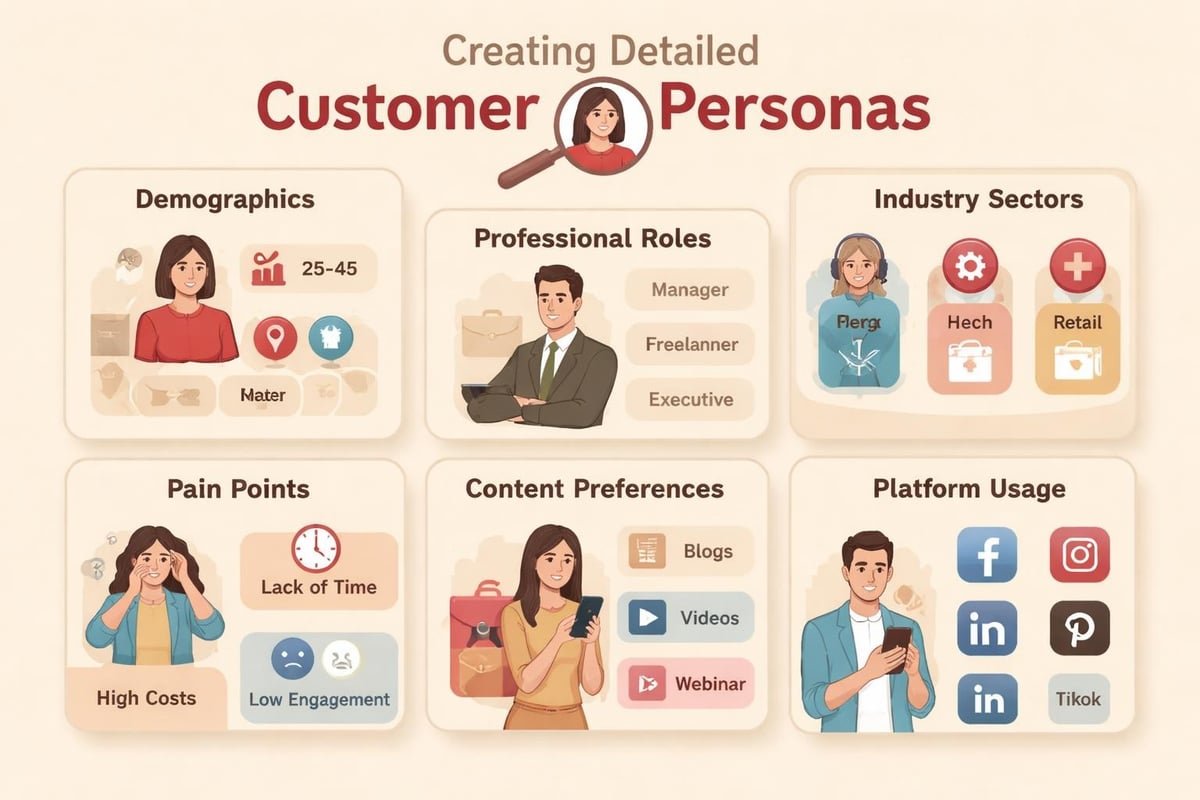
Develop detailed audience personas that include demographics, pain points, information consumption habits, and platform preferences. A construction company owner scrolling LinkedIn during morning coffee has different needs than a healthcare administrator researching solutions during lunch breaks.
Key audience research methods:
- Analyze existing customer data from your CRM and sales records
- Review website analytics to understand visitor behavior patterns
- Conduct surveys or interviews with current clients
- Monitor competitor audiences and engagement patterns
- Use social listening tools to track industry conversations
Understanding your audience’s behavior helps determine which platforms deserve your investment and what content formats will drive results.
Platform Selection Based on Audience Presence
Not every platform deserves equal attention. A digital marketing agency serving B2B clients might prioritize LinkedIn while a retail brand focuses on Instagram and Facebook.
Match platforms to where your audience actively seeks information and engages with content. Oil and gas professionals frequent LinkedIn for industry insights, while healthcare decision-makers might split time between LinkedIn and Twitter for staying current on regulations and innovations.
Content Strategy and Calendar Development
Content forms the backbone of any social media marketing strategy. Successful brands maintain consistency while adapting to platform-specific best practices and audience preferences.
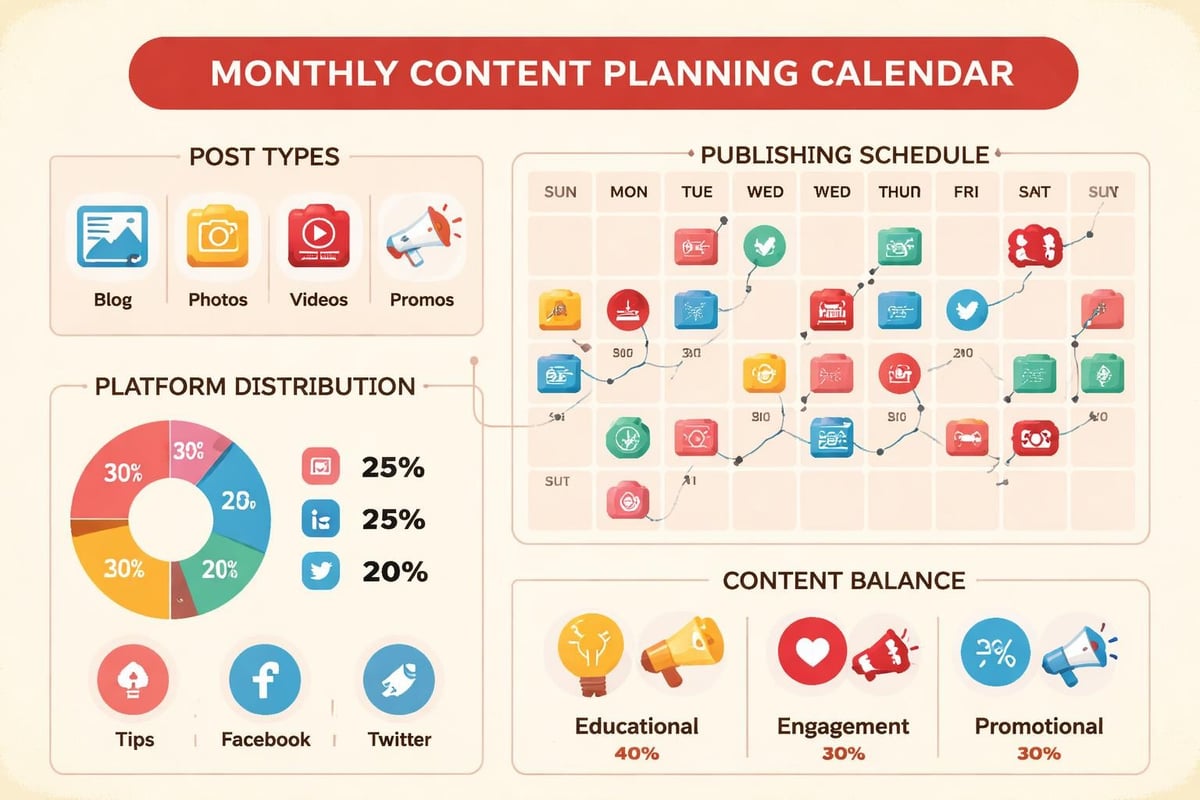
Develop a content mix that balances educational value, entertainment, and promotional messaging. The 80/20 rule remains relevant: 80% of content should inform, educate, or entertain, while 20% can directly promote your services or products.
Content Categories for Diverse Industries
Educational content establishes expertise and builds trust:
- Industry trend analysis and insights
- How-to guides addressing common challenges
- Case studies demonstrating successful outcomes
- Expert interviews and thought leadership pieces
Engagement content builds community and encourages interaction:
- Questions prompting audience responses
- Polls gathering opinions on industry topics
- User-generated content showcasing customer experiences
- Behind-the-scenes glimpses into your company culture
Promotional content drives conversions when used strategically:
- Service announcements with clear value propositions
- Limited-time offers creating urgency
- Client testimonials and success stories
- Event invitations and webinar registrations
Creating a comprehensive social media marketing approach requires planning content weeks or months in advance while maintaining flexibility for timely, relevant posts.
Building Authentic Brand Voice and Consistency
Your brand voice should remain recognizable across all platforms while adapting tone slightly for each channel’s culture. A professional services firm might maintain formality on LinkedIn while showing personality on Instagram.
Sharing valuable content regularly and maintaining consistent messaging builds trust over time. Audiences learn what to expect from your brand, which strengthens recognition and loyalty.
Voice consistency elements:
- Vocabulary and terminology choices
- Sentence structure and length
- Use of humor or emotional appeals
- Visual branding elements
- Response patterns in comments and messages
For companies operating across multiple industries, this consistency becomes particularly important. Whether addressing healthcare administrators or construction managers, your core values and communication approach should remain identifiable.
Visual Identity Across Platforms
Consistent visual branding reinforces recognition and professionalism. Use the same profile images, cover photos that reflect current campaigns or seasonal themes, and color schemes that align with your overall branding strategy.
Templates for different content types maintain visual consistency while streamlining production. Create templates for quote graphics, stat presentations, blog post promotions, and client testimonials that incorporate your brand colors, fonts, and logo placement.
Engagement and Community Management
Publishing content represents only half of social media success. Active engagement transforms followers into community members and customers into advocates.
Respond promptly to comments, questions, and messages. Addressing customer concerns quickly demonstrates commitment to customer service and builds public trust when handled professionally.
Community management best practices:
- Set response time goals (ideally within 2-4 hours during business hours)
- Develop templates for common questions while personalizing responses
- Take complex issues to private messages after acknowledging publicly
- Thank users for positive feedback and tag them when sharing user content
- Monitor brand mentions even when not directly tagged
Active engagement also means initiating conversations rather than waiting for audiences to come to you. Comment on industry news, participate in relevant discussions, and share insights that add value to ongoing conversations.
User-Generated Content and Social Proof
Featuring user-generated content provides authentic social proof while strengthening relationships with existing customers. Share client success stories, repost customer photos featuring your work, and celebrate client achievements.
Always request permission before sharing user content and provide proper attribution. This respectful approach encourages more customers to share their experiences while protecting your brand reputation.
Paid Social Advertising Integration
Organic reach continues declining across most platforms, making paid advertising an essential component of a complete social media marketing strategy. Strategic ad spending amplifies your best-performing content and reaches audiences beyond your current followers.
| Ad Type | Best For | Average Cost | Key Metric |
|---|---|---|---|
| Awareness Campaigns | Brand visibility | $5-15 CPM | Reach, Impressions |
| Engagement Campaigns | Community building | $0.50-3.00 per engagement | Engagement rate |
| Traffic Campaigns | Website visits | $0.25-1.50 CPC | Click-through rate |
| Lead Generation | Contact capture | $5-50 per lead | Cost per lead |
| Conversion Campaigns | Sales, bookings | $10-100 per conversion | ROAS, conversion rate |
Start with small budgets to test messaging, creative variations, and audience segments. Scale investment toward combinations that deliver the strongest return on ad spend.
Retargeting for Maximum Impact
Retargeting campaigns reach people who previously engaged with your content or visited your website. These warm audiences convert at significantly higher rates than cold prospects, making retargeting one of the most cost-effective paid strategies.
Implement pixel tracking on your website to build custom audiences based on specific behaviors like visiting service pages, downloading resources, or abandoning contact forms. Creating a comprehensive digital marketing approach includes coordinating paid social with other channels for maximum impact.
Analytics and Performance Measurement
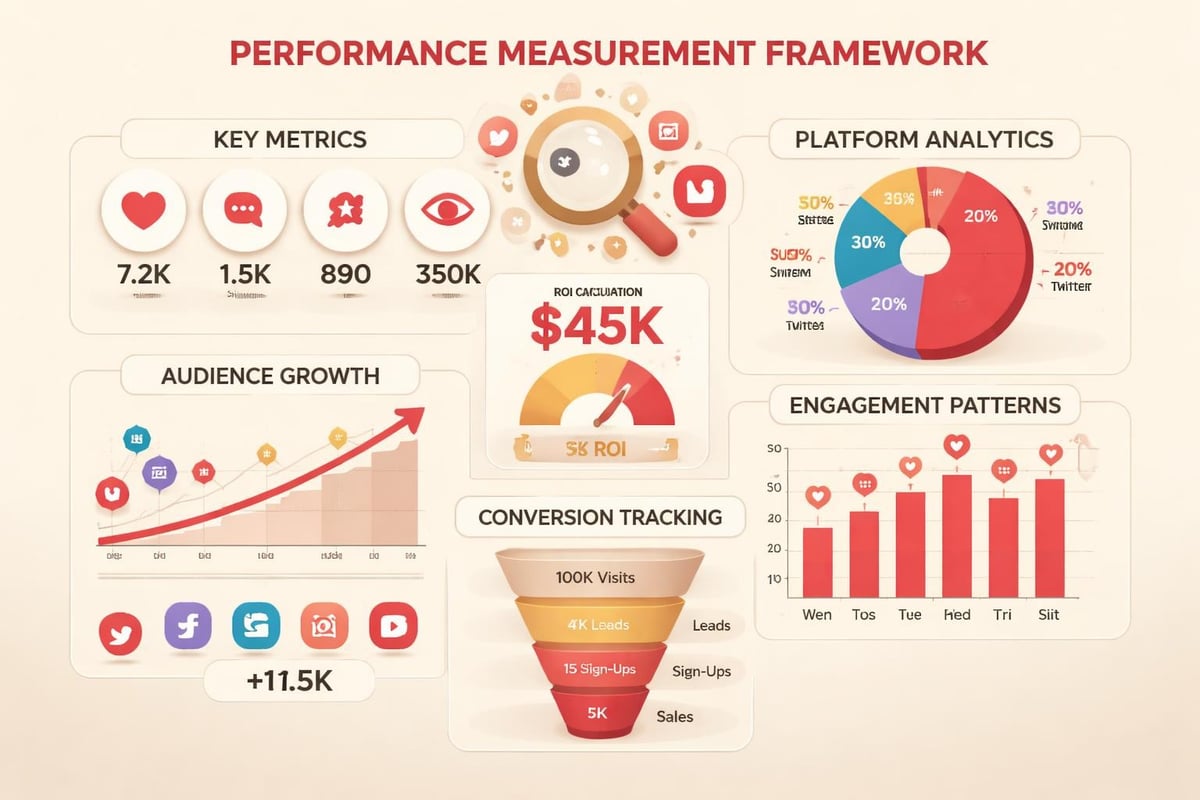
Data-driven decision-making separates effective social media marketing strategies from those based on guesswork. Track metrics that directly connect to your business objectives rather than vanity metrics that look impressive but don’t drive results.
Essential metrics by objective:
- Brand awareness: Reach, impressions, follower growth rate, share of voice
- Engagement: Engagement rate, comments, shares, saves, click-through rate
- Traffic: Social referral traffic, bounce rate, pages per session
- Lead generation: Cost per lead, lead quality score, conversion rate
- Sales: Revenue attributed to social, customer acquisition cost, lifetime value
Review performance weekly to catch issues early and monthly to identify trends and opportunities. Quarterly reviews should inform strategic adjustments and budget reallocation.
A/B Testing for Continuous Improvement
Systematic testing reveals what resonates with your specific audience rather than relying on general best practices. Test one variable at a time: post timing, content format, headline variations, visual styles, or call-to-action placement.
Document test results and apply learnings to future content. Over time, this data-driven approach compounds, significantly improving overall performance as you optimize based on proven results rather than assumptions.
Competitive Analysis and Market Positioning
Understanding competitor social media activities provides valuable insights while helping you identify differentiation opportunities. Analyze which content types generate engagement, posting frequency, tone and voice, response strategies, and advertising approaches.
Look for gaps in competitor coverage where you can establish thought leadership. If competitors focus heavily on product features, emphasize customer success stories and educational content that addresses pain points.
Competitive analysis framework:
- Identify 5-7 direct and indirect competitors in your market
- Audit their presence across major platforms
- Track their posting frequency and content mix
- Analyze engagement patterns and audience responses
- Note their unique positioning and messaging themes
- Identify opportunities for differentiation
This analysis should inform rather than dictate your strategy. Developing a digital business strategy means finding your unique voice rather than copying competitors.
Crisis Management and Reputation Protection
Every social media marketing strategy needs protocols for handling negative feedback, public criticism, or larger reputation crises. How you respond during challenging moments significantly impacts long-term brand perception.
Develop response guidelines before issues arise. Determine who has authority to respond on behalf of the company, what situations require escalation, and how to balance transparency with discretion.
Crisis response principles:
- Acknowledge issues quickly, even if you don’t have complete information yet
- Take heated discussions to private channels after public acknowledgment
- Avoid defensive or dismissive language that escalates situations
- Provide updates as you work toward resolution
- Learn from incidents to prevent recurrence
Monitor brand mentions across platforms, including misspellings and variations of your company name. Early detection allows faster response before small issues become larger problems.
Building Positive Brand Sentiment
Proactive reputation management prevents many crises before they develop. Consistently deliver value, engage authentically, admit mistakes transparently, and celebrate customer successes publicly.
When working with a web and digital agency that understands reputation management, you gain partners who help protect and enhance your brand across all digital channels.
Industry-Specific Considerations
Different industries require tailored approaches within your overall social media marketing strategy. Healthcare organizations navigate HIPAA compliance while sharing valuable health information. Construction companies showcase completed projects while addressing safety and quality concerns. Oil and gas firms balance technical expertise with environmental responsibility messaging.
Healthcare social media priorities:
- Patient education without providing medical advice
- Compliance with privacy regulations
- Physician and staff spotlights humanizing care
- Community health initiatives and partnerships
Construction industry focus:
- Project showcases with before/after comparisons
- Safety culture and training emphasis
- Team member features highlighting expertise
- Process transparency building trust
Oil and gas considerations:
- Technical innovation and efficiency improvements
- Environmental stewardship and sustainability efforts
- Safety records and workforce development
- Community investment and local economic impact
Partnering with specialists who understand your industry ensures your social media marketing efforts address sector-specific challenges and opportunities.
Long-Term Strategy Evolution
Social media platforms, algorithms, and user behaviors constantly evolve. Your social media marketing strategy must adapt while maintaining core brand consistency.
Schedule quarterly strategy reviews that assess platform changes, emerging channels, shifting audience preferences, competitive landscape developments, and your own business evolution.
Building an effective 8-step social media strategy provides a framework, but successful execution requires ongoing refinement based on performance data and market changes.
Stay informed about platform updates, algorithm changes, and new features that might benefit your objectives. Early adoption of new tools often provides temporary competitive advantages before markets become saturated.
Future-proofing your strategy:
- Diversify platform presence to reduce dependence on any single channel
- Build owned audiences through email lists and community platforms
- Focus on authentic relationships over gaming algorithms
- Invest in evergreen content that maintains value over time
- Develop internal capabilities alongside agency partnerships
The most successful social media marketing strategies balance consistency with flexibility, maintaining core brand values while adapting tactics to changing conditions.
Developing and executing an effective social media marketing strategy requires expertise, consistency, and ongoing optimization across multiple platforms and audience segments. Whether you’re looking to strengthen your existing social presence or build a comprehensive approach from scratch, Red Van Creative brings over 25 years of experience helping Houston businesses create authentic connections with their audiences. Our team understands the unique challenges facing industries from healthcare to oil and gas, and we’re ready to help you achieve measurable results through strategic social media marketing.