
In 2026, the pace of change in digital marketing is accelerating, making it crucial for every business to stay ahead of the curve. Companies that fail to evolve risk being left behind by more agile competitors.
This comprehensive guide offers a proven roadmap to mastering digital marketing for company success in today's fast-moving landscape. Discover the latest trends, step-by-step strategies, and actionable tactics designed for measurable growth.
Learn how to select the best channels, track performance, and future-proof your digital marketing for company results. Ready to thrive? Let’s unlock your full potential with this essential strategy guide.
Understanding the 2026 Digital Marketing Landscape
In 2026, the digital marketing for company landscape is experiencing unprecedented transformation. Businesses are navigating a blend of advanced technology, shifting consumer expectations, and evolving regulations. To thrive, companies must understand the critical trends, leverage new data, and anticipate both challenges and opportunities ahead.
Key Digital Marketing Trends for 2026
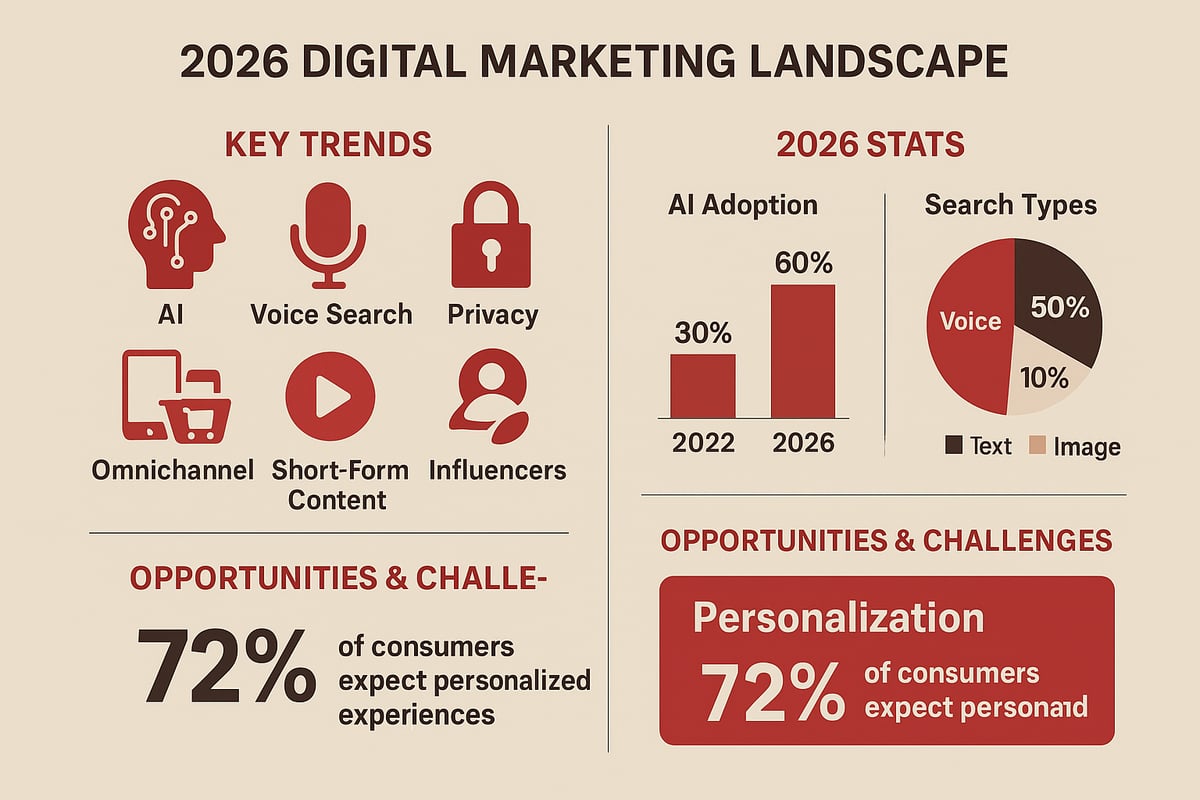
The digital marketing for company environment is shaped by several dominant trends in 2026. AI-driven personalization is now at the forefront, enabling brands to deliver tailored experiences and automate complex workflows. Automation tools reduce manual effort, allowing marketing teams to focus on strategy and creativity.
Voice and visual search continue to grow, with consumers relying on smart speakers and image recognition for information and shopping. This shift demands an updated approach to SEO and website optimization. Privacy-first marketing is another defining trend. With stricter data regulations and the decline of third-party cookies, companies must prioritize transparent data collection and consent-based tracking.
Omnichannel engagement is essential, integrating online and offline touchpoints for seamless customer journeys. Short-form and interactive content—think TikTok, Instagram Reels, and quizzes—caters to audiences with limited attention spans. Influencer and micro-influencer partnerships help brands build trust through authentic voices. Lastly, sustainability and social responsibility are no longer optional, as consumers expect brands to align with ethical and environmental values.
- AI-driven personalization and automation
- Voice and visual search optimization
- Privacy-first marketing strategies
- Omnichannel engagement across platforms
- Short-form, interactive content creation
- Influencer and micro-influencer collaborations
- Commitment to sustainability and social impact
These trends are reshaping the digital marketing for company blueprint, requiring agile adaptation and forward-thinking strategies.
Data and Statistics
The numbers behind digital marketing for company strategies underscore the urgency for evolution. According to Gartner, 72% of companies increased AI adoption in marketing by 2025, signaling a rapid shift toward intelligent automation. Statista reports that 58% of searches are now voice or image-based, highlighting the necessity to optimize for non-text queries. Additionally, Salesforce found that 80% of consumers expect real-time personalization, reinforcing the importance of data-driven engagement.
A closer look at recent data:
| Metric | Value | Source |
|---|---|---|
| AI adoption in marketing | 72% | Gartner |
| Voice/image-based search | 58% | Statista |
| Real-time personalization demand | 80% | Salesforce |
For even more detailed insights, explore the latest AI in marketing statistics 2026 to understand how artificial intelligence is transforming every aspect of digital marketing for company growth.
These figures reflect a market where companies that invest in AI, search innovation, and personalization are positioned to outperform competitors.
Challenges and Opportunities
The rapid evolution of digital marketing for company strategies brings both obstacles and openings. One major challenge is balancing automation with the human touch. While AI and automation streamline processes, genuine engagement still requires empathy, creativity, and emotional intelligence.
Adapting to the constant emergence of new channels and technologies can strain resources and expertise. Companies must remain flexible, investing in ongoing training and platform experimentation. However, these challenges also present significant opportunities.
Early adopters of emerging platforms and innovative content formats often secure a competitive edge. The shift toward privacy-first marketing can build consumer trust, while embracing sustainability and social responsibility enhances brand reputation.
By staying agile and proactive, businesses can turn digital marketing for company challenges into catalysts for growth and innovation.
Building a Future-Proof Digital Marketing Strategy
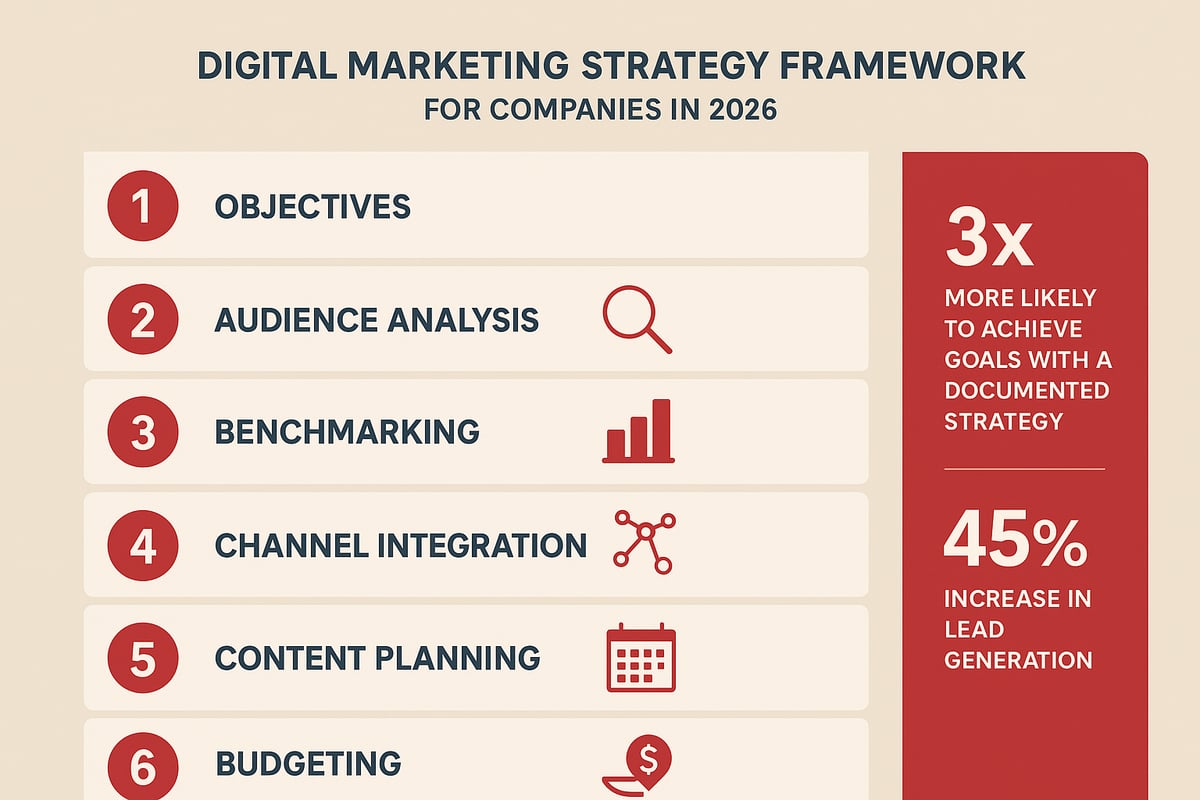
Achieving sustainable growth requires a robust digital marketing for company approach that adapts to change and leverages the latest innovations. A future-proof strategy is not a one-time plan but a dynamic framework that evolves with your business, audience, and the digital landscape. Below, explore a step-by-step process designed for 2026.
Step 1: Setting Clear Business and Marketing Objectives
Begin your digital marketing for company journey by aligning digital goals with your overall business vision. Set SMART objectives, making sure each goal is Specific, Measurable, Achievable, Relevant, and Time-bound.
For example, a company might aim to increase qualified leads by 30 percent through digital channels within 12 months. Use a table to clarify your objectives:
| Goal | Metric | Timeline |
|---|---|---|
| Increase leads | +30% | 12 months |
| Boost website traffic | +40% | 6 months |
| Improve engagement rate | +25% | 9 months |
Clear objectives create focus and accountability, forming the foundation for a resilient digital marketing for company strategy.
Step 2: Audience Analysis and Persona Development
Success in digital marketing for company efforts depends on a deep understanding of your audience. Use advanced analytics tools and social listening platforms to collect real-time data and uncover trends.
Segment your audience into detailed personas. For instance, leverage AI to predict customer behavior, enabling hyper-targeted campaigns that speak directly to individual needs.
Regularly revisit and refine your personas to ensure your digital marketing for company strategy remains relevant as customer expectations evolve.
Step 3: Competitive Benchmarking
Competitive benchmarking is crucial for digital marketing for company success. Use tools like SEMrush or SimilarWeb to track competitors’ digital activities, content strategies, and engagement levels.
Identify market gaps where your company can stand out. Analyze which tactics work best for competitors and where they fall short. This process helps you spot opportunities for differentiation and innovation.
Benchmarking also enables you to measure your digital marketing for company performance against industry standards, ensuring you stay ahead.
Step 4: Channel Selection and Integration
Choosing the right mix of channels is essential for a future-proof digital marketing for company plan. Evaluate options such as search, social, email, content marketing, paid media, and emerging platforms.
Integration is key. Omnichannel consistency ensures that customers experience your brand seamlessly, whether online or offline. For a deeper look at combining web and marketing efforts, explore web and marketing integration for practical strategies.
Select channels based on your audience’s preferences and habits, and ensure all touchpoints deliver a unified message.
Step 5: Content Planning and Creation
Content is the engine of digital marketing for company growth. Develop a data-driven content calendar that balances evergreen resources with trending topics. Use analytics to identify what resonates with your audience.
Mix formats such as articles, videos, interactive webinars, and even AR or VR experiences to keep engagement high. Interactive content, in particular, encourages participation and builds loyalty.
Regularly audit and update your content to maintain relevance in your digital marketing for company program.
Step 6: Budgeting and Resource Allocation
Effective budgeting is the backbone of digital marketing for company success. Assess the ROI for each channel, allocating resources to those that drive the highest value.
Be agile—reserve part of your budget for experimentation with new platforms or tactics. This flexibility allows your company to quickly adapt to market changes.
Use a simple list to organize your budgeting process:
- Prioritize high-performing channels
- Allocate funds for testing new ideas
- Invest in automation and analytics tools
Step 7: Implementation Roadmap
Transform your digital marketing for company strategy into action with a clear implementation roadmap. Assign task ownership, create timelines, and use agile marketing sprints for adaptability.
Break large projects into manageable tasks and review progress regularly. Collaboration and communication among teams ensure that everyone is aligned with the overall vision.
A well-structured roadmap keeps all stakeholders accountable and drives continuous improvement in digital marketing for company initiatives.
Key Insights
Companies with a documented digital marketing for company strategy are three times more likely to achieve their goals. Real-world results demonstrate that refining your approach can lead to a 45 percent increase in lead generation.
By following these steps, your company can build a resilient, scalable strategy that adapts to new technologies and market demands. The path to future-proof digital marketing for company success starts with a plan—review, refine, and repeat for continuous growth.
Essential Digital Marketing Channels and Tactics for 2026
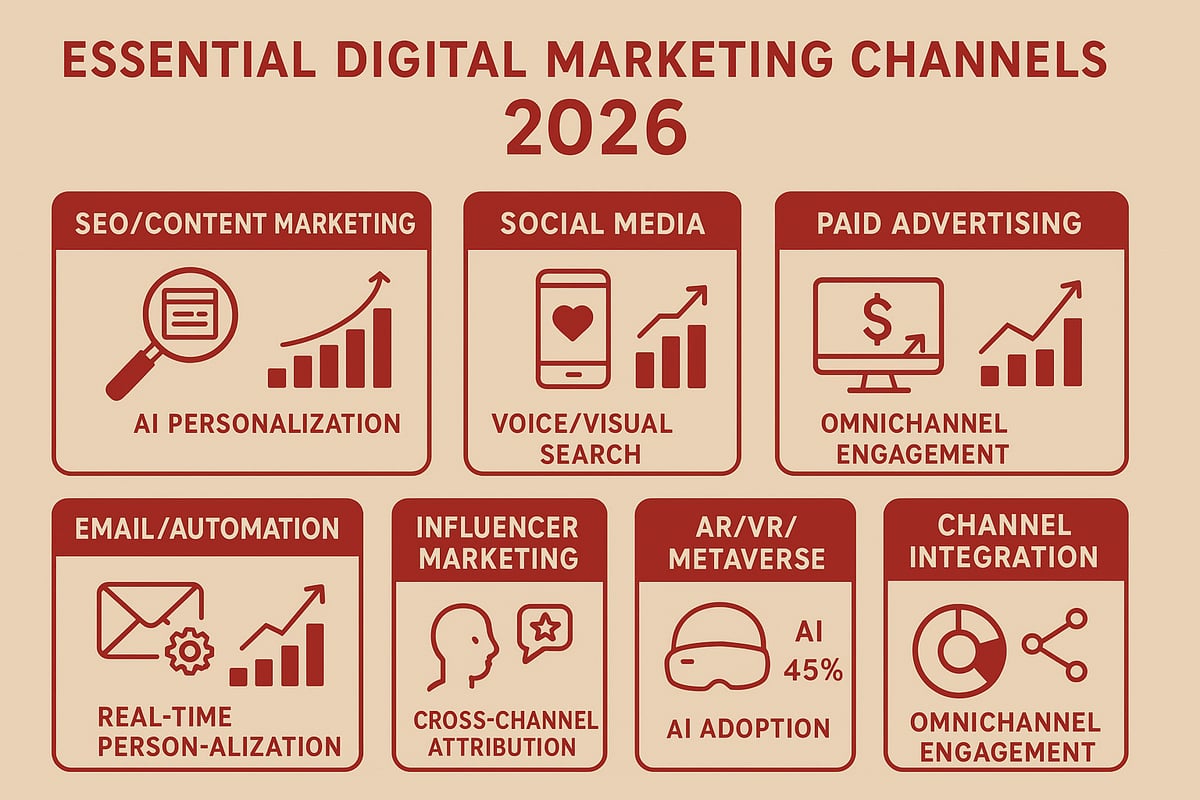
In 2026, digital marketing for company success demands a blend of innovation, agility, and data-driven execution. The landscape is more fragmented and fast-moving than ever, requiring organizations to master both foundational channels and emerging tactics. Let’s explore which channels and techniques will drive growth, elevate engagement, and future-proof your marketing strategy.
Search Engine Optimization (SEO) and Content Marketing
SEO and content marketing remain the backbone of digital marketing for company growth in 2026. With over half of searches now voice or image-based, optimizing for non-text queries is critical. Brands must focus on structured data, schema markup, and video content to improve visibility. E-E-A-T principles—experience, expertise, authoritativeness, and trustworthiness—are essential for ranking and building trust.
Interactive and short-form content, such as explainers and product demos, drive engagement. To see how these tactics work in practice, explore this resource on digital marketing for retail companies. Companies should continually analyze keyword trends, update evergreen content, and ensure every touchpoint aligns with user intent.
Social Media Marketing and Community Building
Social media is evolving rapidly, offering new ways for digital marketing for company initiatives to connect with audiences. Platforms like TikTok, Instagram Reels, and LinkedIn Groups are ideal for fostering communities and delivering live, interactive content. Social commerce is on the rise, making it easier for users to discover and purchase products directly within their preferred networks.
To maximize results, businesses must select platforms that align with their target personas. Engaging content, timely responses, and active participation in conversations are key. Building authentic relationships and leveraging user-generated content further strengthen community ties.
Paid Advertising and Programmatic Media Buying
Paid advertising in 2026 is defined by automation, AI-powered bidding, and privacy-first retargeting. For digital marketing for company objectives, programmatic ad platforms enable real-time targeting and dynamic creative based on user behavior. As third-party cookies disappear, marketers must pivot to contextual targeting and first-party data strategies.
Retargeting remains powerful but requires transparent consent and value-driven messaging. Companies should regularly test ad formats and placements, monitoring ROI to ensure budgets are allocated to the most effective campaigns. Data-driven experimentation supports ongoing optimization.
Email and Marketing Automation
Email continues to deliver strong ROI, especially when paired with advanced automation. Hyper-personalization, powered by AI-driven segmentation, allows digital marketing for company campaigns to address individual needs at scale. Automated drip campaigns, triggered by user actions or lifecycle stages, nurture leads and boost conversions.
Integrating email with other channels—such as SMS or in-app messaging—creates seamless customer journeys. Marketers should prioritize deliverability, mobile optimization, and engaging visuals to stand out in crowded inboxes. Regular A/B testing refines messaging and timing for optimal performance.
Influencer and Partnership Marketing
Influencer and partnership marketing are vital components of digital marketing for company expansion. The trend is shifting toward micro-influencers and niche experts, who offer authentic engagement and higher trust. Identifying the right partners involves analyzing audience overlap, values alignment, and historical performance.
Measuring ROI goes beyond vanity metrics. Focus on metrics like conversions, brand sentiment, and customer retention. Companies should co-create content, host joint events, and encourage long-term partnerships for sustained impact. Transparent collaboration is essential for credibility and results.
Emerging Channels: AR/VR, Metaverse, and Web3
The next frontier for digital marketing for company leaders includes immersive technologies. Brands are experimenting with AR product try-ons, VR showrooms, and virtual events in the metaverse. Early adopters can differentiate themselves and offer unique, memorable experiences.
Web3 technologies open new opportunities for decentralized engagement and digital ownership. Businesses should monitor these trends, pilot small-scale campaigns, and gather insights before scaling. Staying agile allows companies to capitalize on emerging platforms as they mature.
Integrating Channels for Maximum Impact
True success in digital marketing for company performance comes from omnichannel integration. Cross-channel attribution models help marketers understand the entire customer journey and optimize touchpoints. Coordinated campaigns ensure consistent messaging, regardless of where the audience interacts.
Regular data analysis and feedback loops enable continuous improvement. By unifying efforts across SEO, social, paid, email, and emerging platforms, companies create a seamless and compelling brand experience that drives sustainable growth.
Measurement, Analytics, and Optimization
In 2026, measurement, analytics, and optimization are the backbone of digital marketing for company success. Companies that harness data-driven insights can adapt quickly, maximize ROI, and outpace competitors. To build a resilient digital marketing for company strategy, understanding what to measure and how to optimize is essential.
Setting Up KPIs and Metrics
Effective measurement begins by defining clear KPIs that align with your business objectives. For digital marketing for company strategies, these metrics should capture every stage of the funnel, from awareness to conversion and retention.
| KPI Type | Example Metric | Purpose |
|---|---|---|
| Traffic | Unique visitors | Gauge reach |
| Engagement | Time on site, shares | Assess content resonance |
| Conversion | Lead form submissions | Measure success |
| CLV | Customer lifetime value | Evaluate long-term impact |
Aligning KPIs with business goals ensures every digital marketing for company effort delivers measurable value.
Advanced Analytics Tools and Dashboards
Selecting the right analytics tools is critical for digital marketing for company performance. AI-powered platforms, such as Google Analytics 4, offer real-time insights and predictive trends. Custom dashboards help visualize key data points, enabling agile decision-making.
Popular tools include:
- Google Analytics 4 for multi-channel tracking
- Tableau or Power BI for custom dashboards
- Hotjar for heatmaps and user journey analysis
With these tools, digital marketing for company teams can identify opportunities and quickly respond to changes.
Attribution Models and Multi-Touch Tracking
Attribution models help digital marketing for company leaders understand which channels drive results. Comparing first-click, last-click, and data-driven attribution reveals the true customer journey.
Multi-touch tracking is vital as users engage across devices and platforms. Overcoming cross-device measurement challenges requires integration of CRM data and unified analytics platforms.
Choosing the right attribution model ensures digital marketing for company investments are allocated to the most effective touchpoints.
Conversion Rate Optimization (CRO)
CRO is the process of increasing the percentage of visitors who take desired actions. For digital marketing for company teams, this means using A/B testing, multivariate experiments, and personalization to improve outcomes.
Personalization, powered by AI-driven segmentation, can significantly boost conversions. For instance, AI-driven personalization boosts conversions by tailoring messaging to user behavior, making every interaction count.
A focus on CRO ensures digital marketing for company strategies are always evolving with user expectations.
Continuous Improvement Process
Optimization is not a one-time task. A successful digital marketing for company approach implements feedback loops and iterative testing. Regular reviews of campaign data lead to actionable insights and incremental gains.
Teams should schedule monthly or quarterly optimization cycles. Documenting learnings and applying them in future campaigns keeps digital marketing for company strategies ahead of the curve.
Industry Benchmarks and Statistics
Industry benchmarks provide context for digital marketing for company performance. In 2026, 60% of marketers report higher ROI from data-driven optimization. Average website conversion rates vary by sector, so comparing your results to industry standards is essential.
Tracking benchmarks ensures digital marketing for company initiatives are competitive and aligned with market leaders. Consistent measurement and optimization drive sustainable growth.
The Role of Digital Marketing Agencies in 2026
Partnering with a digital marketing agency can be a game-changer for companies aiming to thrive in a rapidly evolving digital landscape. As digital marketing for company growth becomes more complex, knowing when and how to leverage agency expertise is essential for sustained success.
When to Partner with an Agency
Determining the right time to engage an agency is crucial for digital marketing for company objectives. Companies often reach a crossroads where internal resources are stretched, or specialized skills are lacking.
Signs your organization may benefit from agency partnership:
- Difficulty scaling marketing efforts effectively
- Gaps in digital expertise or emerging technology knowledge
- Limited time to keep up with industry trends and tools
Recognizing these signals early allows companies to act strategically, ensuring their digital marketing for company efforts remain competitive and aligned with business goals.
How Agencies Add Value
Agencies bring a wealth of specialized skills and cutting-edge tools to digital marketing for company initiatives. They offer expertise in analytics, creative, and campaign execution that many internal teams may not possess.
Key ways agencies add value include:
- Access to industry-leading platforms and data-driven strategies
- Ability to quickly adapt campaigns as trends shift
- Delivering measurable results through proven methodologies
For deeper insights on how agencies can elevate your approach, explore Digital marketing agency insights. Leveraging agency capabilities can help companies maximize ROI and accelerate growth in digital marketing for company strategies.
Choosing the Right Agency Partner
Selecting the right agency is a critical step in digital marketing for company performance. A thorough evaluation ensures alignment with your unique needs and market expectations.
Consider these criteria:
- Industry experience and proven results in your sector
- Comprehensive service offerings, including branding, SEO, and paid media
- Transparency in communication and reporting
- Local market knowledge for regionally focused campaigns
- Strong client testimonials and relevant case studies
Taking a methodical approach to agency selection increases the likelihood of a successful and lasting partnership in digital marketing for company advancement.
Red Van Creative: A Houston-Based Digital Marketing Agency
Red Van Creative stands out as a trusted partner for digital marketing for company growth in Houston and beyond. Their holistic approach integrates branding, web development, SEO, and targeted advertising for consistent, measurable outcomes.
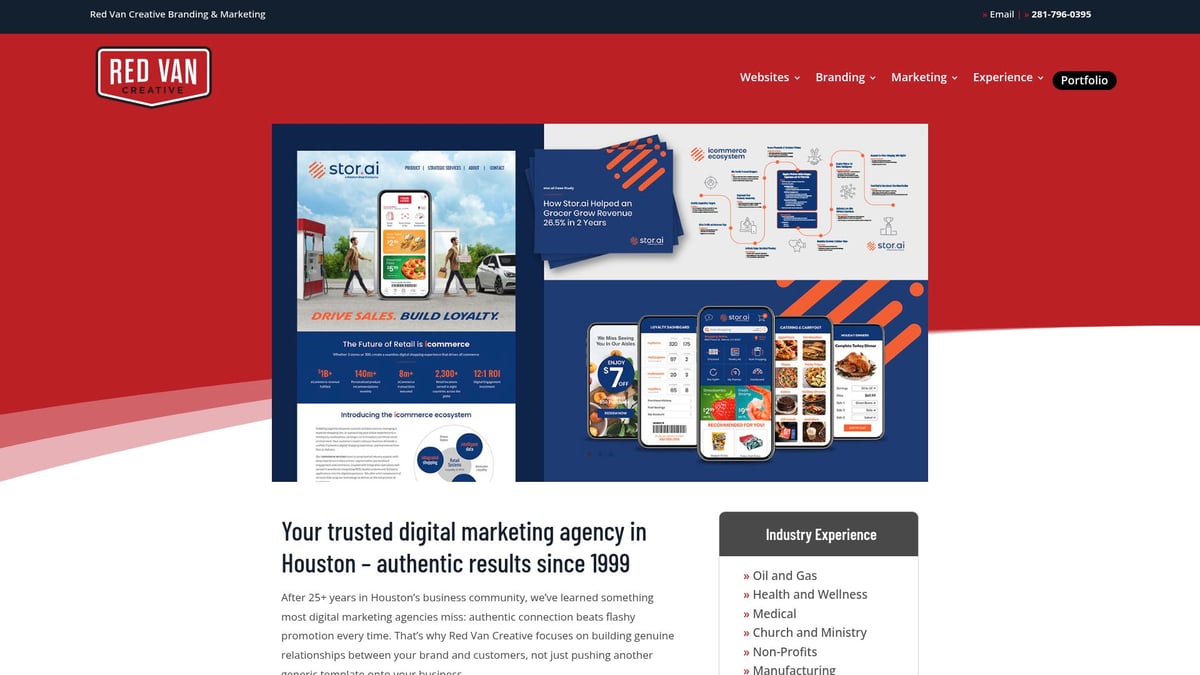
With a track record of success in oil and gas, healthcare, construction, and retail, Red Van Creative emphasizes authentic, relationship-driven marketing. The agency offers flexible engagement models, from project-based support to fractional CMO services, adapting to each client’s needs.
Their award-winning portfolio and client-first philosophy position them as a top choice for companies seeking digital marketing for company excellence and local expertise.
Future-Proofing Your Digital Marketing: Preparing for What’s Next
Adapting to tomorrow’s challenges is essential for digital marketing for company success. Companies that anticipate change, invest in agility, and prioritize ethics will outperform competitors in 2026 and beyond.
Staying Ahead of Technology and Consumer Behavior
Digital marketing for company requires constant vigilance as technology and consumer expectations evolve rapidly. Invest in continuous learning, encourage team members to attend industry events, and subscribe to trend reports. Early adoption of tools like AI chatbots or immersive platforms can differentiate your brand.
Monitor shifts in consumer behavior through analytics and feedback. Companies that understand and adapt to these shifts will maintain a competitive edge.
Building Agile, Adaptable Teams
Resilience is vital for digital marketing for company teams. Foster a culture where experimentation is encouraged, and cross-functional collaboration is the norm. Agile workflows, such as marketing sprints, help teams respond swiftly to new data or unexpected disruptions.
Encourage regular training and knowledge sharing. Empower team members to propose innovative solutions and test new ideas in controlled environments.
Scenario Planning and Risk Management
Proactive scenario planning is crucial in digital marketing for company strategy. Map out potential risks, such as regulatory changes or platform disruptions, and develop contingency plans for each scenario. Regularly review and update these plans as the landscape shifts.
Create a risk management table to track threats, likelihood, and impact. This approach ensures your team is prepared, not just reactive.
| Risk Type | Likelihood | Impact | Contingency Plan |
|---|---|---|---|
| Data Regulation | High | Severe | Update compliance |
| Platform Changes | Medium | Moderate | Diversify channels |
| Tech Failures | Low | High | Backup systems |
Leveraging Data for Predictive Marketing
Harnessing data is essential for digital marketing for company leaders aiming to anticipate market changes. Predictive analytics, powered by AI, can identify emerging trends, inform campaign timing, and optimize resource allocation. According to recent studies, Generative AI’s role in marketing is now a proven driver of ROI and strategic foresight.
Set up dashboards to visualize key metrics and run regular forecasting exercises. Teams that leverage these insights will stay one step ahead.
Sustainability and Ethical Marketing
Modern consumers expect digital marketing for company initiatives to align with ethical and environmental standards. Build transparency into your messaging, prioritize data privacy, and showcase your company’s commitment to social responsibility.
Embed sustainable practices into every campaign. This not only meets customer expectations but strengthens brand trust for the long term.
As you look ahead to building a resilient digital marketing strategy for 2026, it helps to see how proven approaches come to life in real-world scenarios. We’ve talked about the importance of authenticity, integrated branding, and staying ahead of industry trends—values we bring to every client partnership. Curious how these strategies translate into measurable results across industries like oil and gas, healthcare, construction, and retail? Take a closer look at our work and see what’s possible when you combine experience with innovation.
See Our Work / View Our Portfolio